Showing posts with label iPad. Show all posts

Sunday, November 24, 2019

Hour of Code 2019: Dance Party!

It seems like “DaNcE pArTy” is the common theme to celebrate this year’s Computer Science Education Week (otherwise known as “Hour of Code”)!

December 9-15, 2019 is the official week that is designated as this year’s Computer Science Education Week, but of course you can host an “Hour of Code” ANY TIME with these free resources:

From Code.org:


Say hello to Dance Party 2019
With the Hour of Code only a few weeks away, we’re excited to unveil the latest additions to one of our most popular activities, Dance Party! You can look forward to new backgrounds, new coding blocks, and new music from artists like Lil Nas X, Nicki Minaj, Panic! At The Disco, Jonas Brothers, Pedro Capó, and Katy Perry. There’s even a brand-new Dance Party character designed by middle schooler Genevieve P from Edison, NJ! Read more on our blog.

From Apple’s Everyone Can Code:

Excerpt from https://www.apple.com/newsroom/2019/11/apple-expands-everyone-can-code-to-bring-more-coding-resources-to-teachers-and-students/  

"New Everyone Can Code Curriculum
The new Everyone Can Code curriculum builds on existing interactive puzzles, guides and activities to make learning to code even more approachable and connected to students’ everyday lives. Everyone Can Code Puzzles is an all-new student guide to Swift Playgrounds where each chapter helps students build on what they already know, experiment with new coding concepts and creatively communicate how coding impacts their lives. A companion teacher guide supports educators in bringing coding into their classrooms with helpful ways to facilitate, deepen and assess student learning.”


This year’s Hour of Code Facilitator Guide features Dance as students program a virtual MeeBot character to dance and then make a video of it. The new Swift Playground activities to accompany this activity are featured in the Swift Playgrounds library. You could even purchase an actual robot that you could build and then program to interact with your code. Even without this purchase, students can have hours of coding fun with dance moves and the virtual robot inside of Swift Playgrounds. 


And so, Let’s Dance with Code!

Tuesday, October 29, 2019

Topics and Trends in Tech Integration (ESU 8 Newsletter article)

Topics and Trends in Tech Integration
By Katie Morrow, ESU 8


The following are current technology integration projects and practices that ESU 8 schools have been busy with recently. Remember that the invitation is always open if you see something from this list that you would like to try in your classroom. Contact us at ESU 8 and we would love to help get something planned in your school!
  • Digital book creation: A digital book is so much more than a book. Rather it is a container/organizer for all kinds of learning! Use a digital book as an investigation journal, a portfolio, a class collection of pages on a larger topic, or even a way to document a school event. Publish and share with the world without wasting any printer ink!
  • Creative media production: Whether a quick project like the greenscreen “Wormhole Challenge” or a class project like content area student-produced videos, students can practice interview skills, speaking skills, editing and creativity. Videos are a universal way to share what is being learned in the classroom with the rest of the world!
  • VR and AR: Virtual and augmented reality can bring content to life. Students can experience apps to take them places they couldn’t normally go: for example the inside of body systems or underneath the ocean floor. Also possible is students creating their own VR and AR creations with tools such as Google's Tour Creator, AR Makr app, or Blippar.
  • Digital resources for research: Utilize World Book online, Learn 360, or Virtual Field Trips to connect your class with first rate global resources- all with virtually no cost. Avoid simply going on a Google search and use higher quality resources for whatever your next educational project may be.
  • Blended Learning and PBL: Here’s a framework or a learning methodology to make your next project more student directed. Student agency empowers learners to be responsible for choices impacting their productivity and understanding of content. Make your next unit more personalized by blending in some project based learning or station rotation experiences.  
  • Gamify with assessment tools: Use technology for your next classroom review session and make learning fun! There are so many readily available formative assessment tools that you can choose a new one each unit so students don’t grow tired of any of them. Even some traditional tools have new features, so ask about ways to gamify that next class review session. 
  • Learning Management System tools like Canvas or Google Classroom: The easiest way to take technology integration to the next level in your classroom is to employ a system of content delivery and student interaction. Even Apple Classroom has updates to make their newest technology more manageable for all. Work with us to uncover ways your LMS can allow for more productive learning environments. 
  • Coding: Expose students to computational thinking by integrating some analog "intro to coding” activities. Or give them time to explore Swift Playgrounds on iPad or the code.org website. Or bring the Sphero programmable robots to your school for a coding kick-off activity. Once you get kids hooked, the sky is the limit for their future!

For additional ideas and examples from ESU 8 schools recently, be sure to check out my Instructional Tech at ESU 8 blog at: https://esu8tech.blogspot.com  

Be creative to help get "back in the groove!"


Back to School time around ESU 8 was filled with new facilities, new personnel, and new expectations for an amazing school year. Many of the activities incorporated a hands-on activity powered by educator creativity.

The following are some of the examples. Can you think of how each activity could be modified for use in your classroom?

Creative Portraits


Expedition Map


Expedition Team Flags


Expedition Team gifs


Wormhole Challenge


Wednesday, May 8, 2019

Pioneer ABCs: Book creation by 1st graders


To bring to life first grade Social Studies learning, this class created an alphabet book based on the "Little House on the Prairie" series and Westward expansion topics. 

First, Mrs. Willis and her students brainstormed topic options for each of the letters of the alphabet, then assigned to her class. 

Next students researched and wrote their "stories," drawing an accompanying picture on paper.

I shared an ABC book template page via Apple Classroom and worked with the students to publish their work in Pages. Many examples of combining pencil and paper artwork with digital artwork were experimented with. 


Students rotated through some "finishing stations" where they recorded audio with Mrs. Willis or were photographed in a pioneer costume.
 

Finally the pages were submitted to me via Apple Classroom so that I could assemble them in a class alphabet book. 


Now published on the Apple Books Store, you can enjoy it here:

For members of our audience without access to Apple Books, we shared the following additional versions:

Wednesday, March 27, 2019

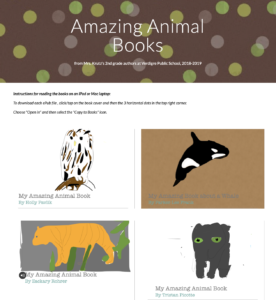
AMAZING Animals books written by AMAZING Authors

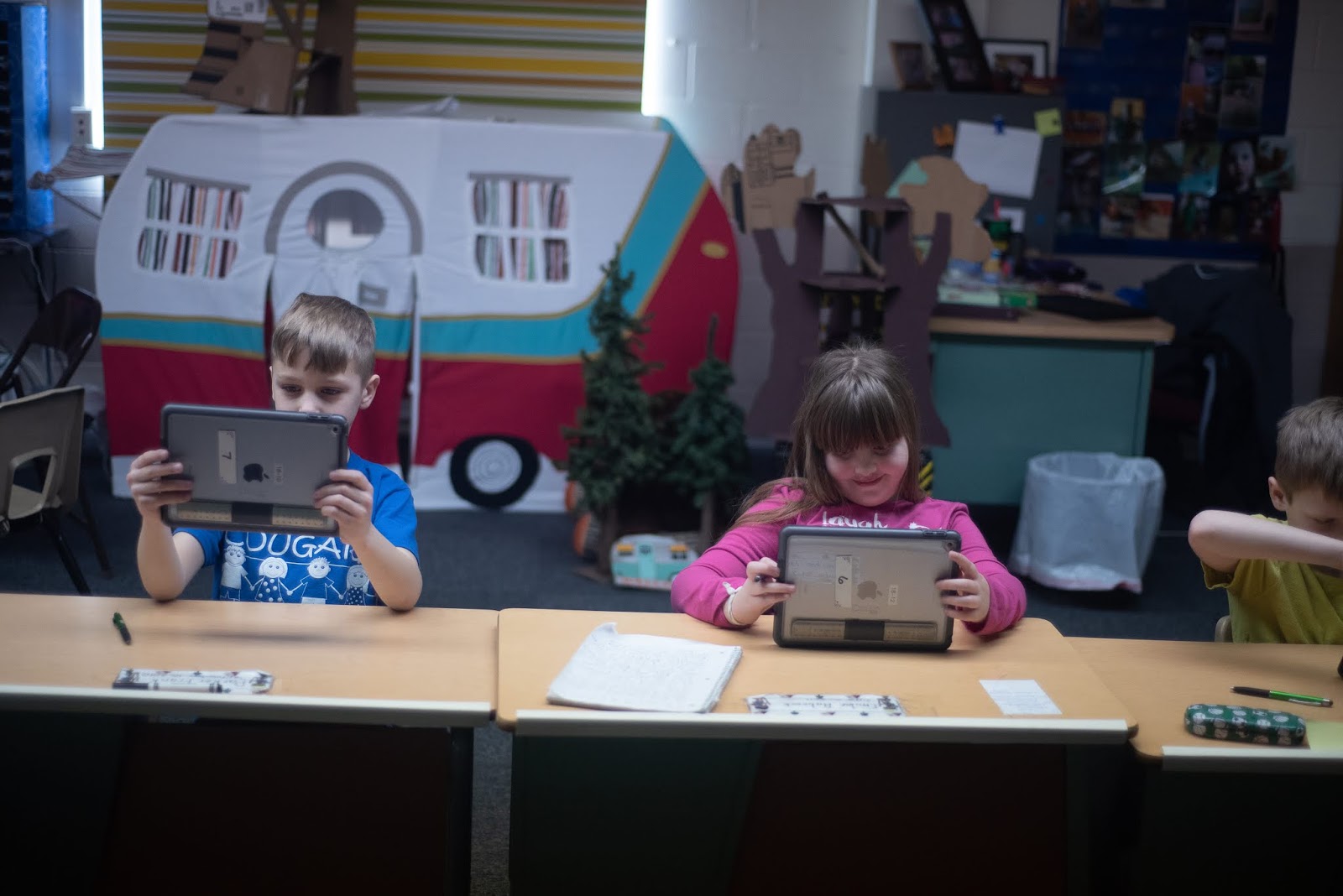
For this 2nd grade class, this was the very first time they had ever used Pages... let alone create a digital book. 

They were excited about becoming authors! (mostly!)
I shared a simple template with them via Apple Classroom so that had a starting point for their Amazing Animal book. 
Download and open in Pages
Our first task was to find a cover image, change the opacity, and use the drawing tools in Pages to create original artwork. When the tracing image was deleted, students were so proud of their digital artwork! 


Of course, capturing "selfies" for their "Author the Author" page was pretty fun, too!
 

Next the students added content from their research on each of the pages, enhancing with copyright-friendly photos, shapes & drawing and even image galleries.  
   

The final step was to record audio. Some students recorded a reading of their entire "report" while others recorded bits of text from multiple pages. 


Students exported as ePubs and "handed in" their books via Apple Classroom, and Mrs. Krutz collected them all. To share with family and friends, I posted the epub files on a webpage and also made a screen recording video of each book, so that an audience without an iPad could still hear the students' voices. 

All in one day's work in a second grade classroom!
Amazing Animal Books by Verdigre 2nd grade


Monday, September 3, 2018

Students Authoring Books with Pages


Every year on September 8, International Literacy Day is celebrated. In conjunction with this year's celebration, AppleEDU has launched a #PagesBookChallenge. The challenge is simple. Create a digital book with your students in Apple's Pages app (free creation app for Mac or iPad). Then, simply tweet a short synopsis of the book along with its cover and tag #PagesBookChallenge.


To encourage all educators to participate here a series of short tips and recommendations for creating digital books with Pages.

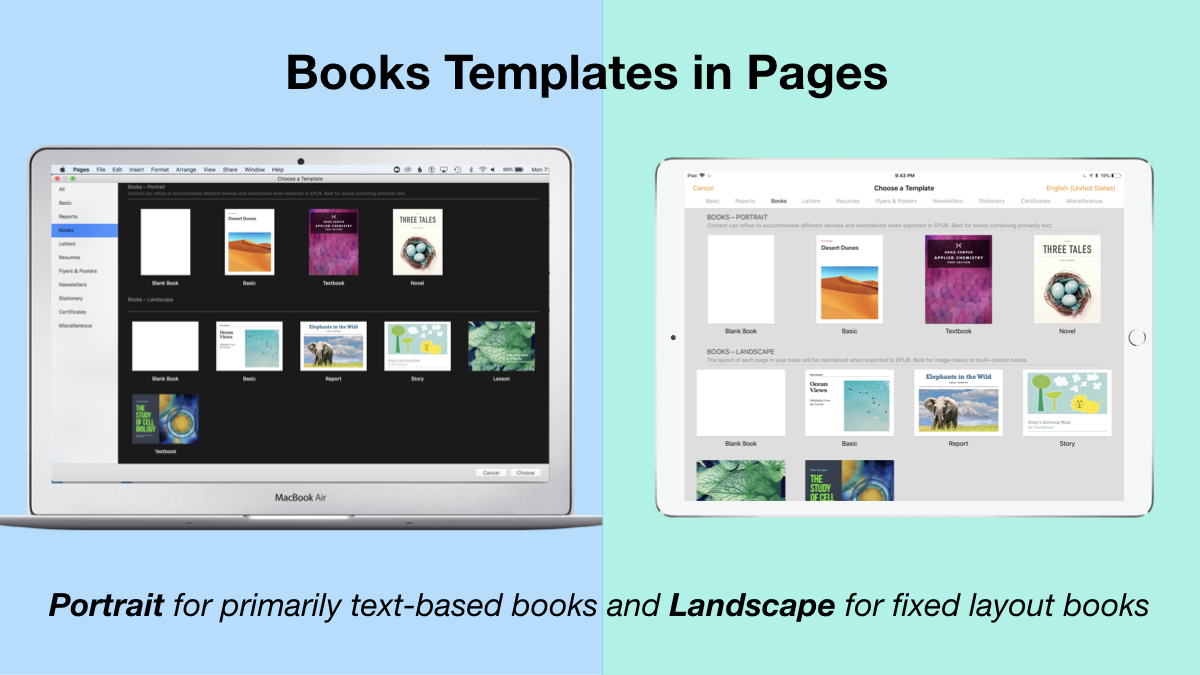
1. Begin a new Pages project using the Books templates.

Tip: Use Portrait templates for primarily text-based books (so that the reader can resize the text and the pages will adjust accordingly) and Landscape for fixed layout books (where you control the exact design and layout of the pages and the reader cannot adjust).

2. Author and Edit as you normally would in the Pages app. 

The beauty of the iWork suite, in my opinion, is its simplicity and consistency across apps. Unleash your creativity!

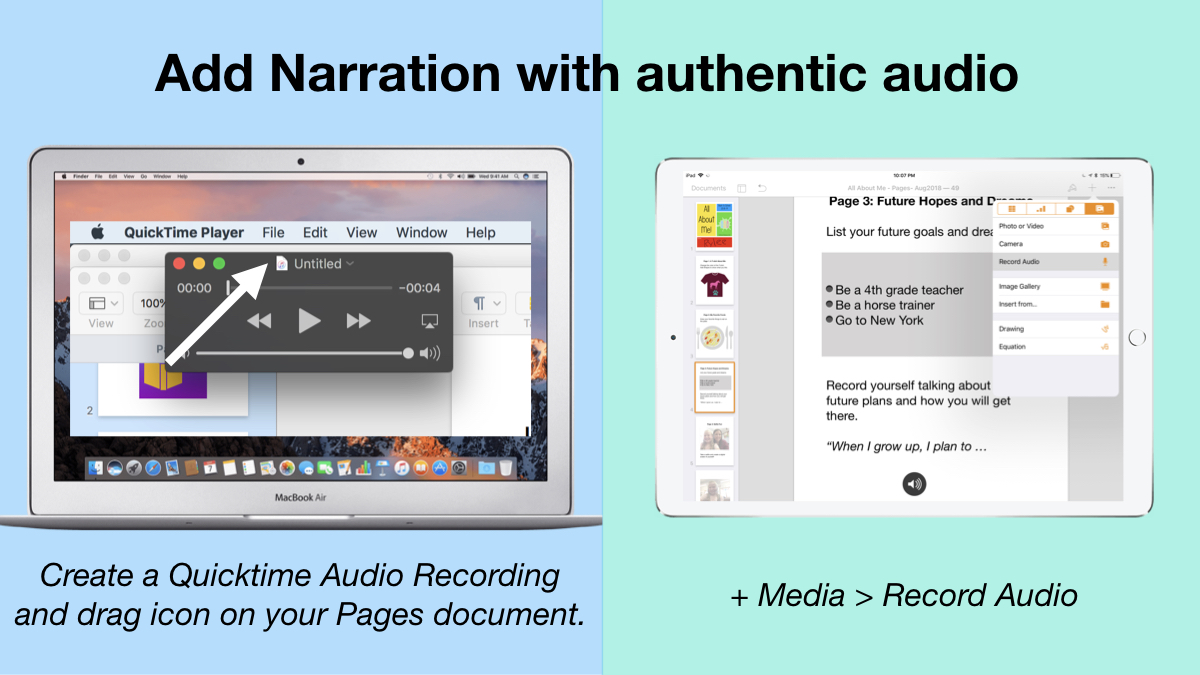
3. Add narration with authentic audio

On Mac: Create a Quicktime Audio Recording and drag icon next to filename onto your Pages document.
On iPad: Tap the +, choose the Media tab, and Record Audio, then add to page.

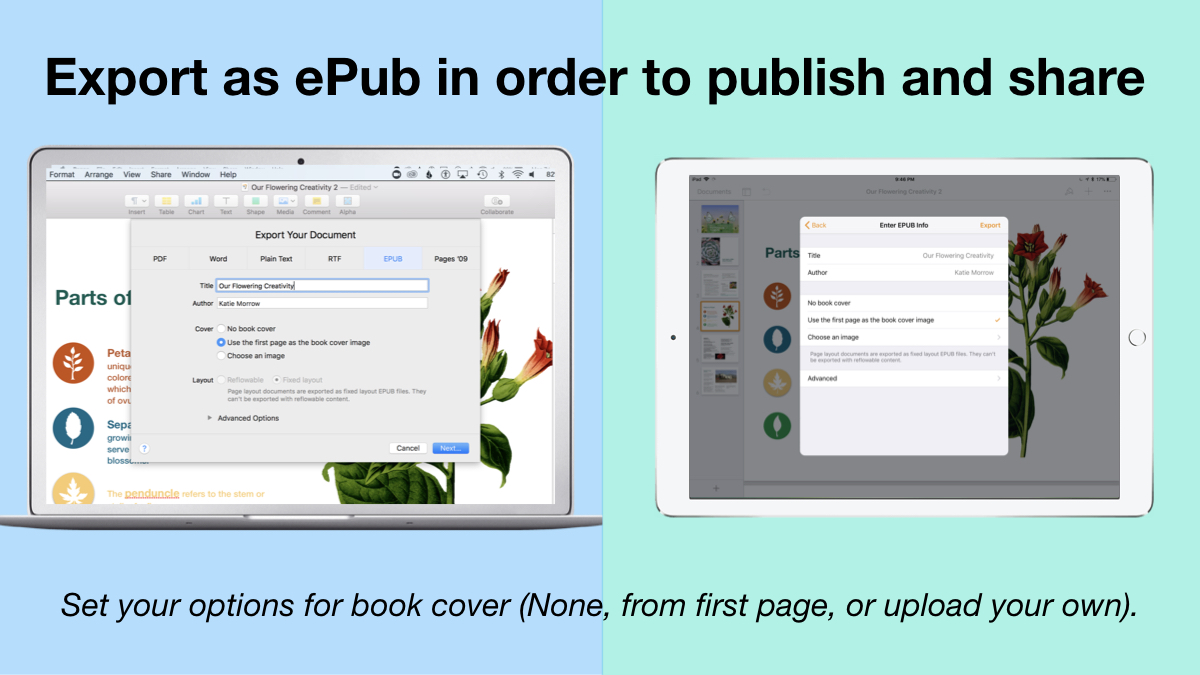
4. Export as ePub for Publishing and Sharing.

Title your book and name the author. Set your options for book cover: (None, from first page, or upload your own).
There you have it! Anyone can create a book with Pages. 


 Student books authored in Pages by Mrs. Troester's English 8 class, Spring 2018. (Science "Explainer" books for younger learners)

As educators the possibilities are endless when authoring books with Pages. To help learners experience authentic authoring, encourage them to work through all stages of the writing process. Here is a 60 second reminder of how to do so within the Apple ecosystem.


Finally, teachers can use Pages templates to help students focus more on the content of their books, and less on the the design of the pages. Whether for professional learning experiences, class books where every student authors a piece, or even shorter individual writing projects, simply create a Pages book as a starting template. Share the Pages document as a starting point and allow the learners to customize the content. Be sure to take advantage of the following features:

Media placeholders

Add image gallery placeholders from the Media button. This is a preset placeholder for the author to add an entire gallery of images.

Add text boxes and utilize Paragraph Styles

Text boxes are automatically ready as placeholders. Simply change the paragraph style and/or formatting.

Build your own photo/video placeholder

Add an image (or screenshot). Select the image and choose:
On Mac: Format > Advanced > Define as Media Placeholder

Add pages as desired and distribute to all your budding authors.  

I cannot WAIT to see what creative ideas you and your students have when creating books in Pages!


Friday, August 31, 2018

4 Types of Sentences... Zoom Clues in Clips!

Shirley Rossman, 4th grade teacher at West Holt Elementary, just finished teaching her students about the four types of sentences. In order to reinforce these key concepts, she had the idea to adapt the concept of "Zoom Clues" videos made in Apple's Clips app and challenge her students to demonstrate mastery.

Here is the project workflow:

  1. Students choose a "mystery object" and author FOUR sentences (one of each of the four sentence types: declarative, imperative, interrogative, and exclamatory) giving clues about the object's identity. 
  2. Students take a photo of their chosen mystery object with the iPad camera. The image should be fairly close up, but show the entire object, as this will be the view shared as the "answer" to the Zoom Clues video. 
  3. Students start a new project in Clips and add a poster image to introduce their video.
  4. From the Library, bring the photo of the mystery object into the "stage." Pinch to zoom in as far  as possible, and position the image in a way that guessing the object could be challenging. Add a label with the first clue and press the big red record button to add to the Clips project. 
  5. Zoom out just a little and/or change the viewpoint, add the second sentence clue with a new label, and record the clip. 
  6. Repeat for the last two sentence clues. 
  7. Add a conclusion slide that shows and reveals the answer.
  8. Add music and export the final video to share it!

Here is a sample "4 Types of Sentences Zoom Clues" that the West Holt 4th graders and I quickly made together, but hopefully soon they will share some more clever examples of student creativity! Check back soon!


Thursday, May 17, 2018

10 Ways to Transform Student iPad Workflow

http://neta18.weebly.com/10-ways-to-transform.html
In a recent NETA 2018 presentation, co-presenter Ann Feldmann and I shared 10 simple ways to reach all learners with built-in iPad features- designed to take learning in your own hands!

Accessibility features were not created merely for learners with disabilities. Rather, with Universal Design for Learning (UDL) principles, all students can be empowered to customize and streamline their own personal workflows.

“Designing learning for all empowers every single student.”
-Ann Feldmann


 Teach a man to fish, and you feed him for a lifetime. 
~Chinese Proverb

"iPad accessibility helps each student be in charge of their own, best learning… for a lifetime."
-Katie Morrow 

The following videos are screencasts to illustrate the slides on the digital handout found at: http://neta18.weebly.com/10-ways-to-transform.html

UDL Guidelines: Provide multiple means of Engagement

1. Assistive Touch


 2. Airdrop

3.  Split Screen + Notes

UDL Guidelines: Provide multiple means of Representation

4. Speak Screen & Speak Selection 

5. Dictation & World Languages


6. Scan & Annotate


7. Screenshot & Annotate


UDL Guidelines: Provide multiple means of Action and Expression 

8. Assistive Touch


9. Screen Recording

10.  Sketch in Keynote